
Where it lives in the app
- Scan screen
Works without
- no labs
- no wearable
- no diagnosis on paper
You're in the aisle with a carton in your hand, reading the back of it for the second time. Somewhere in that list is the thing you half remember reading about, and you can't tell which one it is. So it goes in the basket anyway, because you've got twenty minutes and a school pickup.
Short answer: Osmi's scanner reads the ingredient list on a product and tells you what's on it that matters for a thyroid condition, why it's on the list, and what to buy instead in the same aisle. Food and drinks on one side, skincare and makeup on the other. Every ingredient it points out comes with the reason it's on the list, never a score out of a hundred. And every one of those notes is an opinion about the product in your hand. Nothing it says is about you, your symptoms, or your results.
What the ingredient scanner does
Point your camera at anything you eat or put on. Osmi reads what the label lists, and only that. The front of a pack is marketing. The back of it is the product, and the back is what gets read.
What comes back isn't a grade. It's a plain answer about those ingredients through the lens of your thyroid condition, with the reasoning spelled out next to each one. You can disagree with the note under an ingredient once you can see the reason. You can't disagree with a number.
Underneath everything it points out is one idea: the closer to nature, the better. How far is this from the thing as it grows, and how many of these ingredients exist only because a factory needed them to. That's what Osmi asks a label first, before anything thyroid specific.
Three habits come with it. It always shows you something better in the same aisle, because a note with no swap is a dead end when you're standing there with a basket. It saves the ingredient, not just the product, so when the same oil turns up in a different brand next month you're not starting over. And when it doesn't know a product well, it says so instead of guessing.
What it points out, and why
| What Osmi points out | Why it's on the list | What you see |
|---|---|---|
| Added sugars, under every name | Cane, coconut, agave, honey, maple, date syrup, juice concentrate, corn syrup, maltodextrin, dextrose. Sugar is sugar. But a whole date isn't a spoon of corn syrup, so Osmi names which kind it is and how processed | Added sugar, Avoid |
| Seed oils | Canola, sunflower, safflower, soybean, corn, cottonseed, grapeseed, rice bran, and the blend that hides as "vegetable oil". Industrially extracted, usually with heat and solvents. Osmi names the fats it points to instead | Rapeseed oil, Avoid |
| Gluten: wheat, barley, rye, malt | The NIDDK says you're more likely to develop Hashimoto's if you have other autoimmune disorders, including celiac disease. Osmi calls out gluten for a Hashimoto's reader without hedging, which is a stronger line than mainstream guidance takes | May contain traces of gluten, Watch |
| Soy | Soy is one of the foods NIDDK names as affecting how well your body absorbs levothyroxine. A 2021 systematic review of 63 studies found limited evidence for those interactions, and noted that all of them pointed the same way, toward less of the medicine being absorbed | Marked, with the reason |
| Iodine, in both directions | NIDDK says that with Hashimoto's you may be sensitive to harmful side effects from iodine, and names kelp, dulse and other seaweed. A 2014 review in Nature Reviews Endocrinology notes the source of an excess might not be readily apparent, which is exactly why a label is worth reading | Marked, with the reason |
| Goitrogens | Raw cruciferous vegetables, cassava, millet. Cooked and in normal amounts, these aren't a concern, and Osmi says that rather than inflating it | Marked, with the reason |
| Everything ultra-processed | Emulsifiers, gums, flavorings, colors, preservatives. Ingredients a recipe never asked for | Marked, with the reason |
| The swap | Same aisle, same category, something you can put in the basket today | A cleaner swap, Better |
Avoid, Watch and Better are the app's own words for a product. They're never used about you.
Food and skincare are read separately
Two lists, because the routes into your body are different. On the food side it's added sugars, seed oils and hidden gluten. On the other side it's skincare and makeup, where fragrance is one of the things Osmi points out.
The reason that half exists at all: the Endocrine Society's second scientific statement on endocrine disrupting chemicals reviewed a subset of topics for which the translational evidence is strongest, and thyroid is one of the seven. That's a statement about a class of chemicals, made by an endocrinology body. It isn't a claim about your skin or your results. The house rule is simpler than the science: if you wouldn't eat it, think twice about putting it on.
What you see when you scan
The camera opens with one line across the bottom: "Line the barcode up in the frame". Line it up, and the read slides over the picture as a sheet.
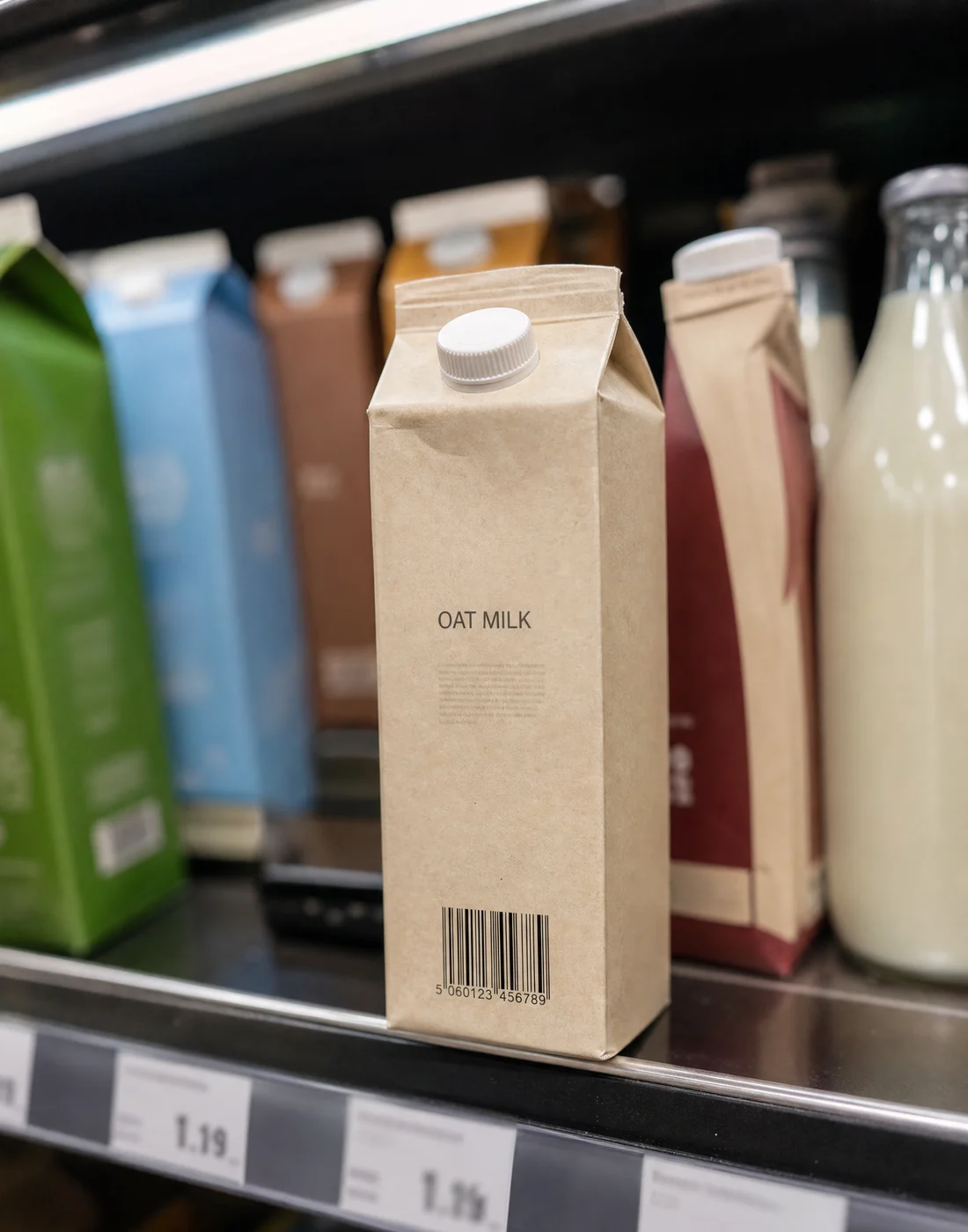
At the top of the sheet is the product, named the way the shelf names it. Under that, the ingredients it marks, one per row, each with its own word. On a barista oat milk, that's "Added sugar" and Avoid, "Rapeseed oil" and Avoid, "May contain traces of gluten" and Watch. Under those rows, "A cleaner swap", and one product: oat milk, oats and water only, Better.
That's the whole screen. Three ingredients marked, a reason for each, and something you can buy instead. It's built to be read in the four seconds before the trolley behind you needs past.
Line the barcode up in the frame
Oat milk, barista
A cleaner swap
What it works without
No labs. No wearable. No ring, no watch, nothing you have to wait for. The scanner works from the day you install it, on its own.
It also works without a diagnosis on paper, which matters more than it sounds. Hashimoto's is diagnosed most often in women between thirty and fifty, but it starts at any age, and plenty of women are reading labels long before anyone has written anything down.
What the rest of the record adds is context. Osmi reads the product against you: your symptoms, your scan history, your cycle, your sleep. What changes is what Osmi looks for, never what it says about you. So the more of your own record sits in Osmi, the more a scan has to go on.
How a scan fits the rest of your record
A scan is dated, and it lands on the same timeline as everything else you record: your daily check-in, your lab album, your cycle, your sleep. Your numbers move two to four times a year. How you feel moves daily. Osmi's whole job is holding those two speeds in one place, and your scans sit in there with them.
That's also the honest limit of it. Osmi will show you a scan and a hard week sitting on the same date. It will never tell you one caused the other, and it will never turn your scan history into a verdict on how you're doing. If you want the wider picture of what the record holds, that's the thyroid tracker and the Hashimoto's tracker.
What Osmi never says
It never tells you a food caused your symptoms, your antibodies or your last result. It never tells you to change your diet as treatment, and it never says a word about your medication. It doesn't grade you, score you, or hand you a daily verdict on your thyroid. It doesn't recommend a supplement or a dose. On the food positions themselves, Osmi is plain that they're its own: NIDDK says that on diet and supplements in Hashimoto's, no specific guidance is currently available.
Strong opinions about a product. Nothing at all about your body. That line is the whole design.
If you want the arguments behind what it points out, they're written out in full: what a scanner should point out for an autoimmune condition and why, the case against seed oils, what makes a read personal to you instead of one score for everyone, and what to look for in a thyroid aware scanner.